Manor Farm
Manor Farm is the physical and symbolic heart of George Orwell's Animal Farm, a small, run-down English farm that becomes the stage for a revolutionary experiment in animal self-government and its subsequent corruption into a tyranny indistinguishable from the human regime it overthrew. The farm's two name changes—first to Animal Farm and finally back to Manor Farm—chart the complete arc of the revolution's rise and fall, making the land itself a monument to betrayed ideals.
Identity and Setting
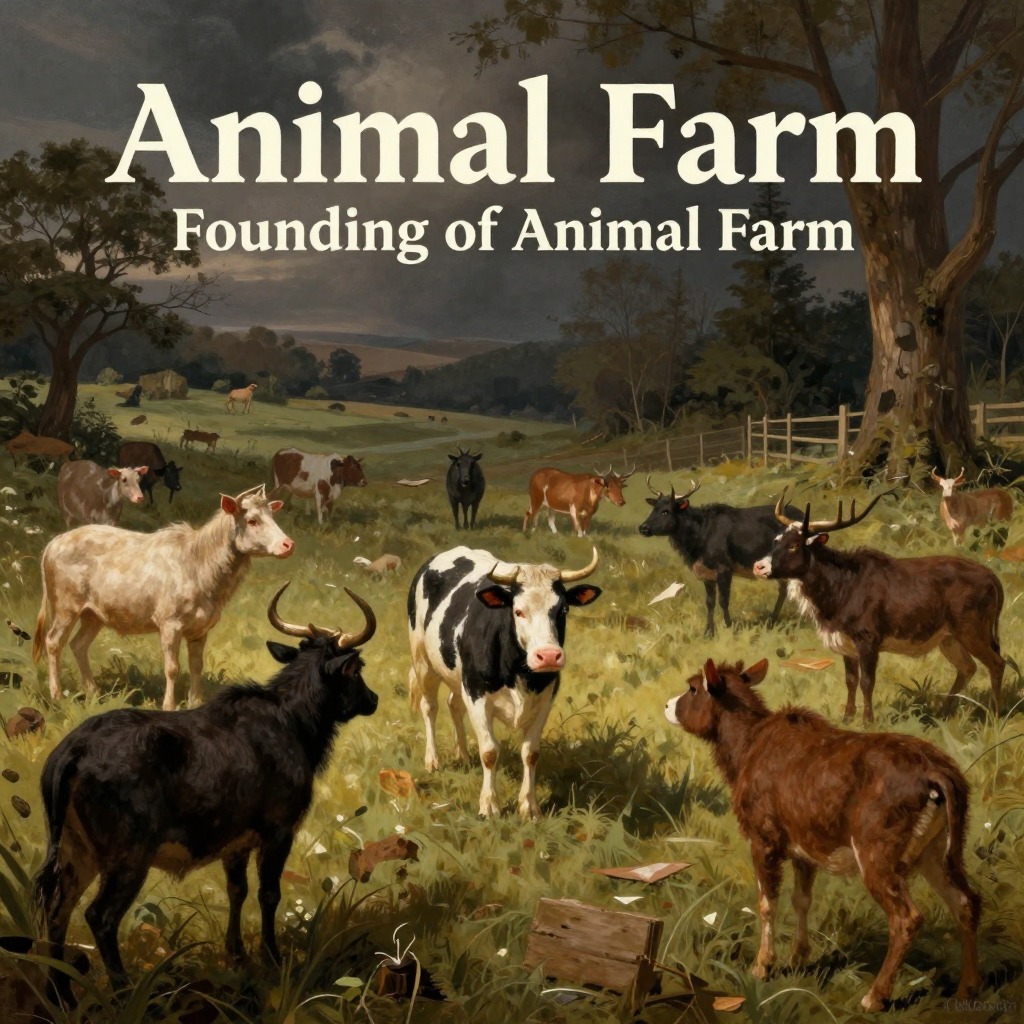
Manor Farm is introduced as the property of Mr. Jones, a drunken and neglectful farmer who has let the estate fall into disrepair. The fields are full of weeds, the buildings need roofing, the hedges are neglected, and the animals are underfed. The farm is located in the English countryside, near the town of Willingdon, and is bordered by two neighboring farms: Foxwood, a large, neglected, old-fashioned estate owned by the easy-going Mr. Pilkington, and Pinchfield, a smaller, better-kept farm run by the tough, shrewd Mr. Frederick. The farm's physical features include a big barn, a cowshed, a harness-room, a store-shed, an orchard, a small paddock, a quarry, a drinking pool, a hayfield, a spinney, a vegetable garden, and a knoll that commands a view of most of the property. The farmhouse itself, with its feather mattresses, looking-glasses, and Brussels carpet, represents the forbidden luxury of human life.
The Rebellion and the Birth of Animal Farm
The Rebellion that transforms Manor Farm into Animal Farm occurs almost by accident. After Mr. Jones gets drunk at the Red Lion in Willingdon and fails to feed the animals for an entire day, the hungry cows break into the store-shed. When Jones and his four men arrive with whips, the animals, in a spontaneous uprising, fling themselves upon their tormentors and drive them off the property. The animals then rename the farm, painting out "Manor Farm" from the five-barred gate and replacing it with "Animal Farm." The farmhouse is preserved as a museum, and the Seven Commandments—the unalterable law of Animalism—are inscribed on the end wall of the big barn. The animals work the land themselves, and for a time the farm prospers: the harvest is the biggest ever seen, and the animals are happy, producing food for themselves rather than for a grudging master.
The Windmill and Economic Hardship
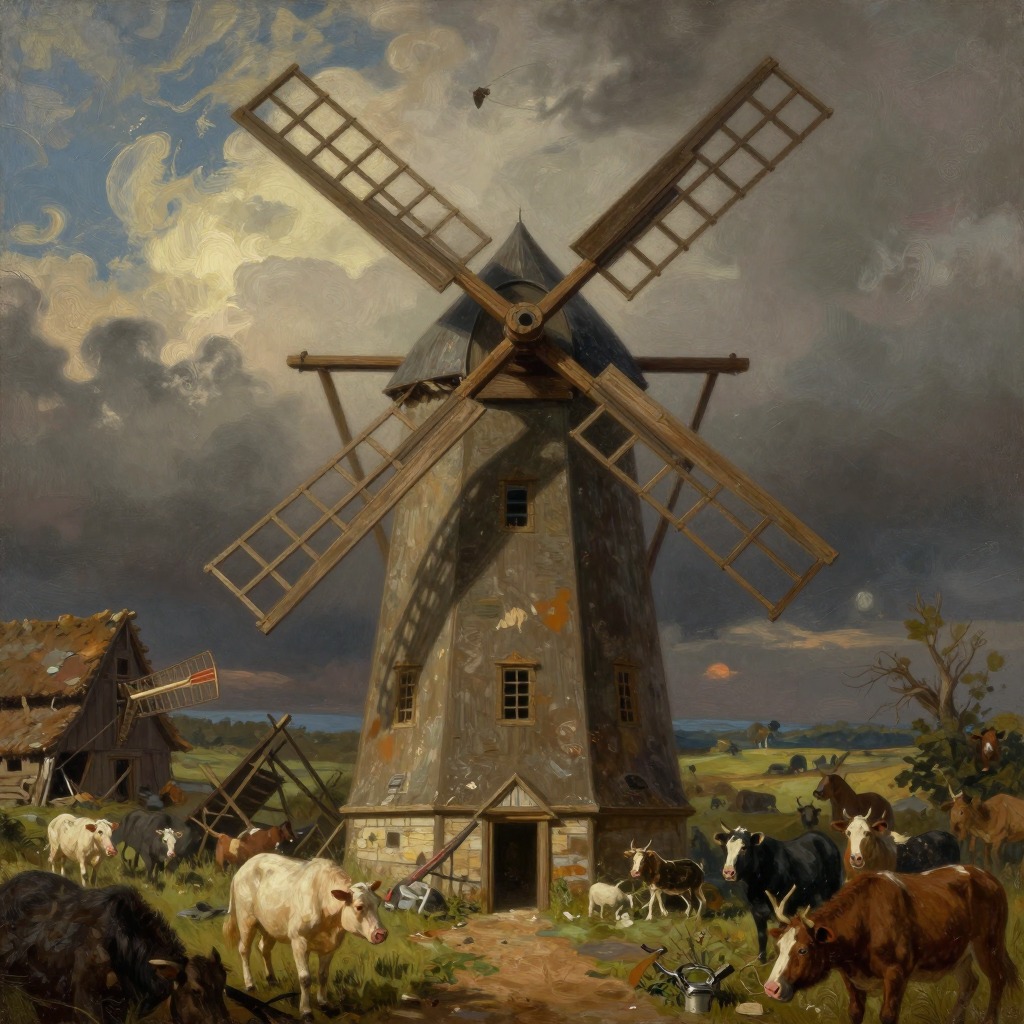
The central project of the Animal Farm era is the construction of a windmill, proposed by Snowball to generate electrical power that would light and warm the stalls and run labor-saving machinery. The windmill becomes a source of bitter conflict between Snowball and Napoleon, and after Napoleon's dogs expel Snowball, Napoleon claims the windmill as his own idea. The building of the windmill consumes the animals' labor for years. The work is exhausting: huge boulders must be dragged up the quarry slope and toppled over the edge to shatter into usable stone. The farm faces constant economic pressure. To obtain necessary materials like paraffin oil, nails, and iron for horseshoes, Napoleon begins trading with neighboring farms, selling hay, wheat, and eggs. The hens are forced to surrender their eggs, leading to a brief rebellion in which nine hens die. Food shortages become chronic: the corn ration is drastically reduced, potatoes are frosted in the clamps, and for days the animals have nothing to eat but chaff and mangels. The windmill is destroyed twice—first by a storm, then by Frederick's men using blasting powder—and each time the animals must rebuild it from the foundations.
The Transformation of the Farm's Identity
The farm's identity undergoes a series of erasures that mirror the corruption of the revolution's principles. The song 'Beasts of England', which expressed the animals' longing for a better society, is abolished after the executions of the traitors, with Squealer declaring that the Rebellion is now completed and the song no longer has any purpose. The green flag, originally marked with a white hoof and horn to signify the future Republic of the Animals, has those symbols removed and becomes a plain green flag. The custom of addressing one another as "Comrade" is suppressed. The skull of Old Major, which had been set up on a stump at the foot of the flagstaff for the animals to file past reverently, is buried. Finally, Napoleon announces that the name "Animal Farm" has been abolished and the farm is to be known once again as "The Manor Farm," which he calls its correct and original name. The Seven Commandments themselves are gradually altered: the Fourth Commandment against sleeping in a bed acquires the qualification "with sheets"; the Sixth Commandment against killing acquires the phrase "without cause"; the Fifth Commandment against drinking alcohol acquires the phrase "to excess"; and finally, the Seventh Commandment, "All animals are equal," is replaced with "All animals are equal but some animals are more equal than others."
The Final State and Narrative Significance
By the end of the novel, Manor Farm has become a prosperous but thoroughly oppressive enterprise. The windmill, completed at last, is used not for generating electrical power but for milling corn, bringing in a handsome money profit. The farm has been enlarged by two fields bought from Mr. Pilkington, and possesses a threshing machine and a hay elevator. But the animals themselves are generally hungry, sleep on straw, drink from the pool, and labor in the fields. The pigs, who now walk on their hind legs, carry whips, wear Mr. Jones's clothes, and sleep in the farmhouse beds, have become indistinguishable from the human beings they overthrew. In the final scene, a deputation of neighboring farmers visits the farm, and Mr. Pilkington toasts "the prosperity of The Manor Farm," while Napoleon, in a black coat and ratcatcher breeches, returns the toast. The creatures outside, looking from pig to man and from man to pig, find it impossible to say which is which. The farm has completed its full circle: from Manor Farm to Animal Farm and back to Manor Farm, with the animals' liberation having produced only a new set of masters.